Scottish eCommerce
Dean’s Shortbread
Overview
The famous Scottish Shortbread brand Dean’s approached us with an urgent brief to create a new eCommerce solution that would allow them to keep ahead of the continued growth online, increase marketing and communications potential and handle large amounts of traffic.
Dean’s is still a family-run business priding itself on using time-honoured handcrafted baking methods, and is recognised as ‘The Leading Premium Quality Scottish Shortbread’.
The Challenge & Objective
Dean’s Shortbread needed to significantly scale online revenue in a competitive FMCG landscape where acquisition costs were rising and margins were under pressure. Their previous digital performance pointed to real, untapped potential across both organic and paid channels, but a set of specific gaps was holding growth back: visibility shortfalls on page one of search, missed opportunities in AI overview placements, and PPC campaigns that were under-optimised and spending inefficiently.
The objective was to close those gaps and build a growth engine where each channel strengthened the others, rather than competing for the same budget. That meant improving organic visibility, capturing new SERP real estate, and making paid media work harder for every pound spent.
Our Solution
mtc implemented a combined SEO and PPC strategy designed to maximise visibility, performance, and the synergy between channels. SEO focused heavily on improving first-page rankings, capturing AI overview placements, and enhancing presence across key SERP features so the brand appeared wherever buyers were searching.
These organic improvements fed directly into stronger PPC performance, lowering acquisition costs and improving overall campaign efficiency. Paid social then layered a full-funnel strategy on top, driving both new customer acquisition and repeat purchases through retargeting. The result was a joined-up approach where better rankings, cheaper clicks, and higher repeat purchase rates reinforced one another.
The Impact
By treating SEO, PPC, and paid social as a single system rather than separate line items, mtc delivered transformational revenue growth built on stronger ranking positions and improved keyword visibility that lifted paid media delivery across every channel:
- +150% increase in PPC revenue with an 883% return on ad spend
- +22% increase in social advertising revenue at a 7x ROAS
- +156% increase in paid search conversions year-on-year
Dean’s Shortbread
Explore The Design

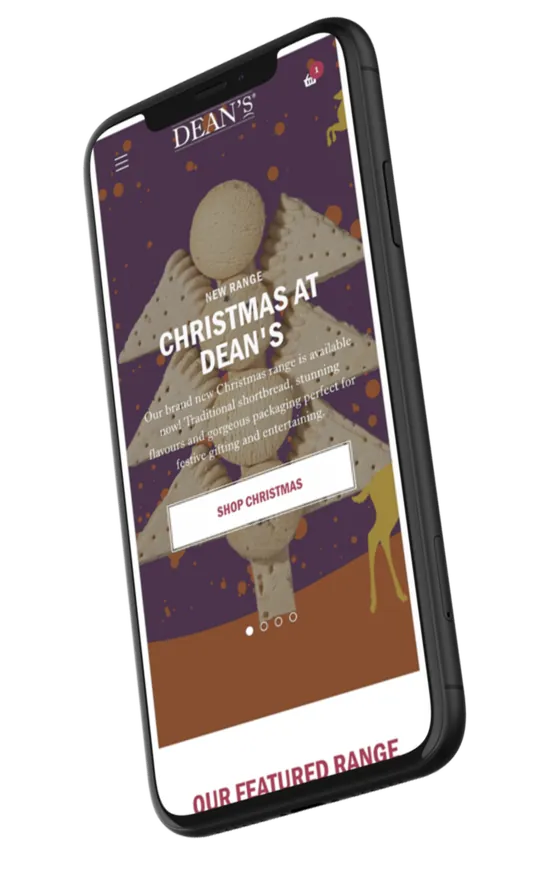
An eCommerce that focusses on selling shortbread and telling the story of the brand.


Insights
Most brands run SEO, PPC, and paid social as separate budgets managed by separate people towards separate targets. That structure quietly caps growth, because the channels are actually deeply connected: strong organic rankings lower the cost of paid clicks, capturing SERP features reduces the need to pay for that visibility, and retargeting turns first-time buyers into repeat revenue. Dean’s Shortbread is a clear demonstration of what happens when you manage them as one system.
As we look at the FMCG and eCommerce landscape in 2026, there are three areas where even well-established brands leave performance on the table. Taking our work for Dean’s as an example, here are the things to consider when auditing your own channel mix.
What we found by working on Dean’s Shortbread:
Organic strength makes paid cheaper. The 883% return on ad spend was not achieved by paid media in isolation. Improved first-page rankings and SERP visibility meant the brand was already trusted and visible when paid campaigns ran, which lowered acquisition costs and lifted the return on every pound.
AI overviews are now a visibility channel in their own right. Capturing AI overview placements is no longer a nice-to-have. As more searches resolve without a click, the brands that appear in those summaries hold an advantage that compounds across every other channel.
Retargeting is where FMCG margin is protected. In a category with rising acquisition costs, the 22% lift in social advertising revenue came in large part from bringing existing customers back rather than constantly buying new ones. The first sale often just covers the cost of acquisition; the profit is in the repeat.
Some challenges for your own site:
Pull your SEO, PPC, and paid social reports and lay them side by side. Are they measured against the same goals, or is each channel optimising in isolation? If a rankings win is not showing up as a lower cost per click in your paid account, your channels are not talking to each other.
Search your top three products and see who owns the AI overview and the featured results. If it is a competitor, they are capturing intent before the buyer ever reaches a paid listing, and you are paying to compete for the leftovers.
Look at how much of your paid budget goes to acquiring brand-new customers versus bringing back people who have already bought. In a rising-cost market, the ratio matters. If everything is aimed at acquisition, you are leaving your most profitable revenue untouched.
Success in a competitive FMCG market in 2026 is not about outspending rivals on any single channel. Dean’s 150% increase in PPC revenue came from the compounding effect of channels that strengthened each other, which is a far more efficient path to growth than buying it outright.
Testimonial
Testimonial
In the Client’s Words
Planning a similar project?
If you're looking to improve your eCommerce platform, customer journey or long-term digital performance, let's talk.
Let's talk